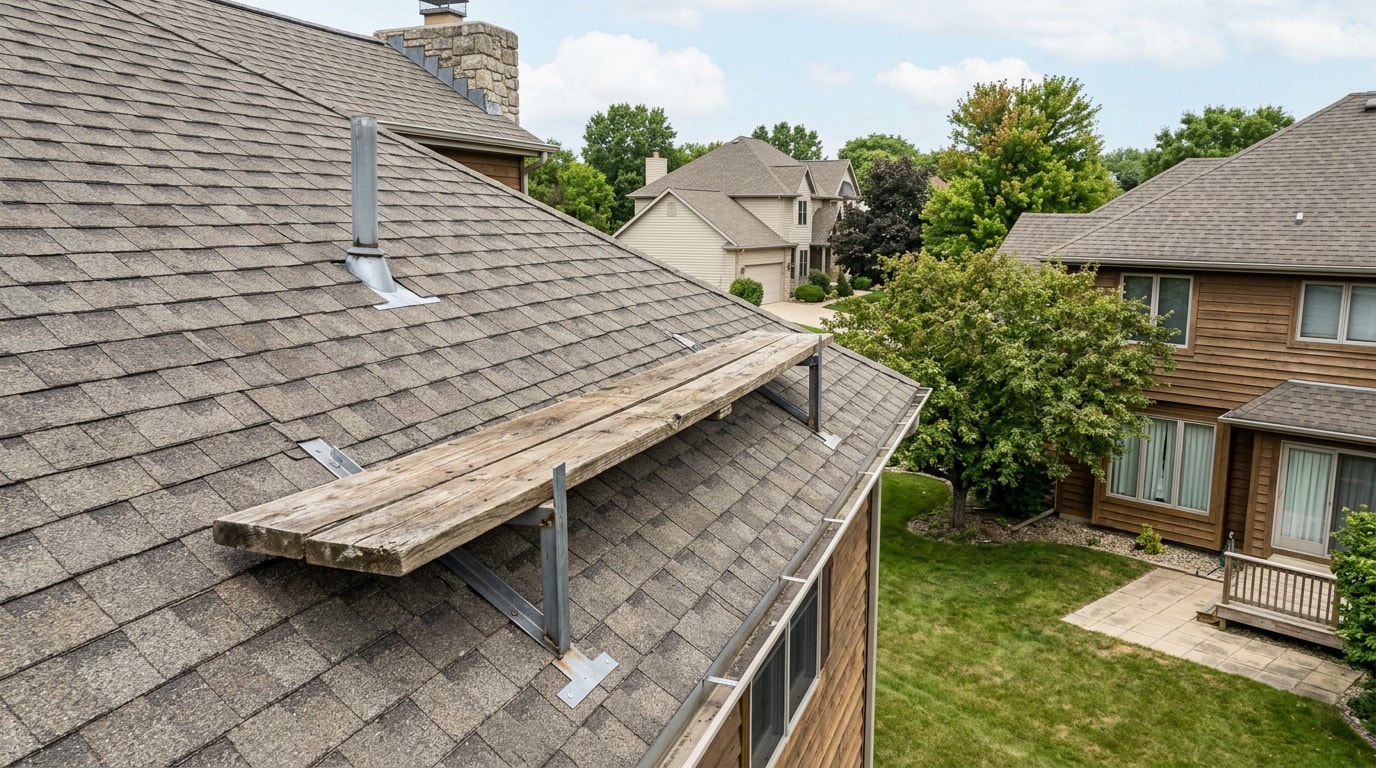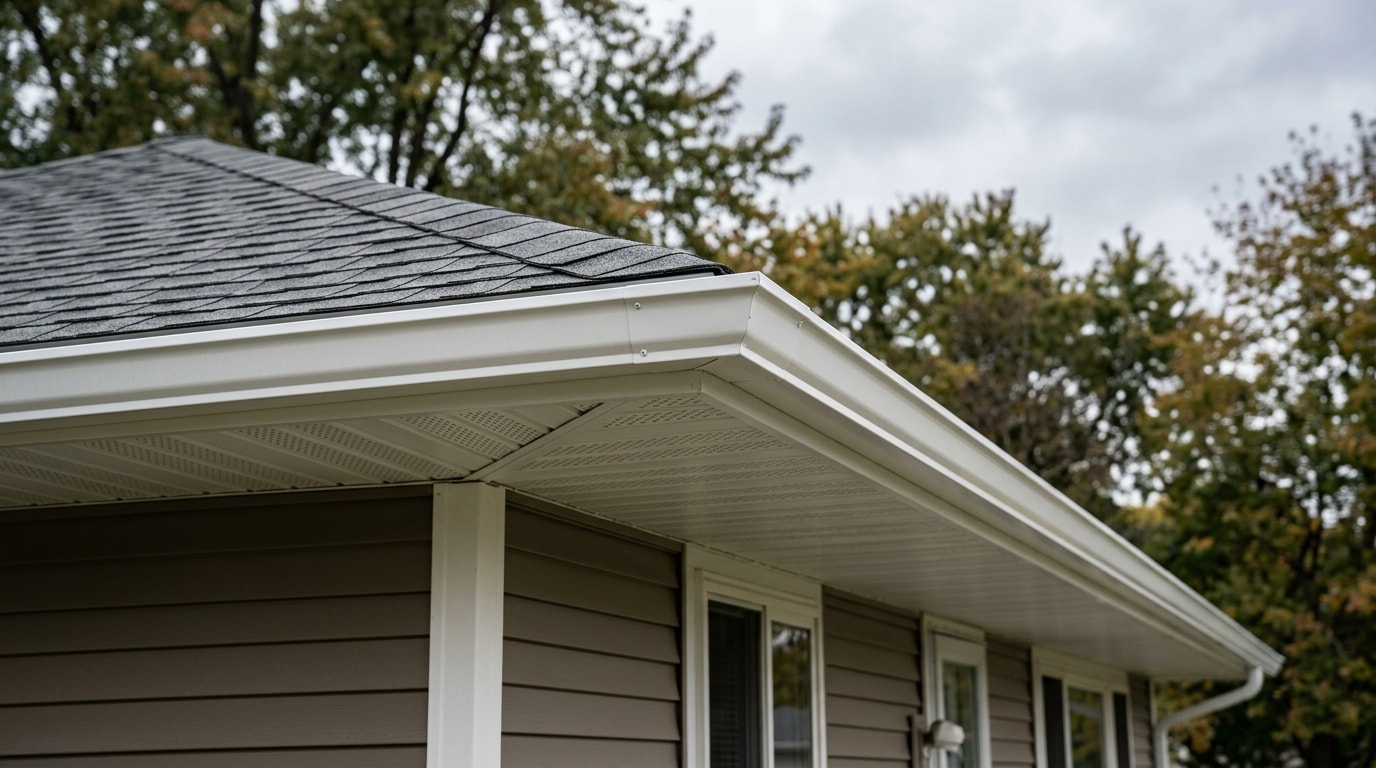

Gutters for metal roof Chatham, IL homes have to be specified for the roof, not just screwed to whatever fascia is there. A standing-seam or exposed-fastener panel releases rain as a fast, concentrated sheet that overshoots an undersized trough and tears hangers loose when snow lets go. Here is what actually holds up on metal roofs in Sangamon County, what it costs in 2026, and how to attach it without putting a hole in a panel.
What Size Gutters Does a Metal Roof Need?
Capacity is the whole game. Metal sheds faster than asphalt, so the trough and the downspouts both have to be bigger than the default a shingle house gets.
Most metal-roof homes here do best with:
- 6 inch seamless K-style gutter instead of the standard 5 inch
- Hangers at 16 to 24 inches on center, tighter on eaves that take snow slide
- One downspout per 30 to 35 feet of run, sized 3x4 rather than 2x3
- Pitch of about 1/4 inch per 10 feet toward each outlet
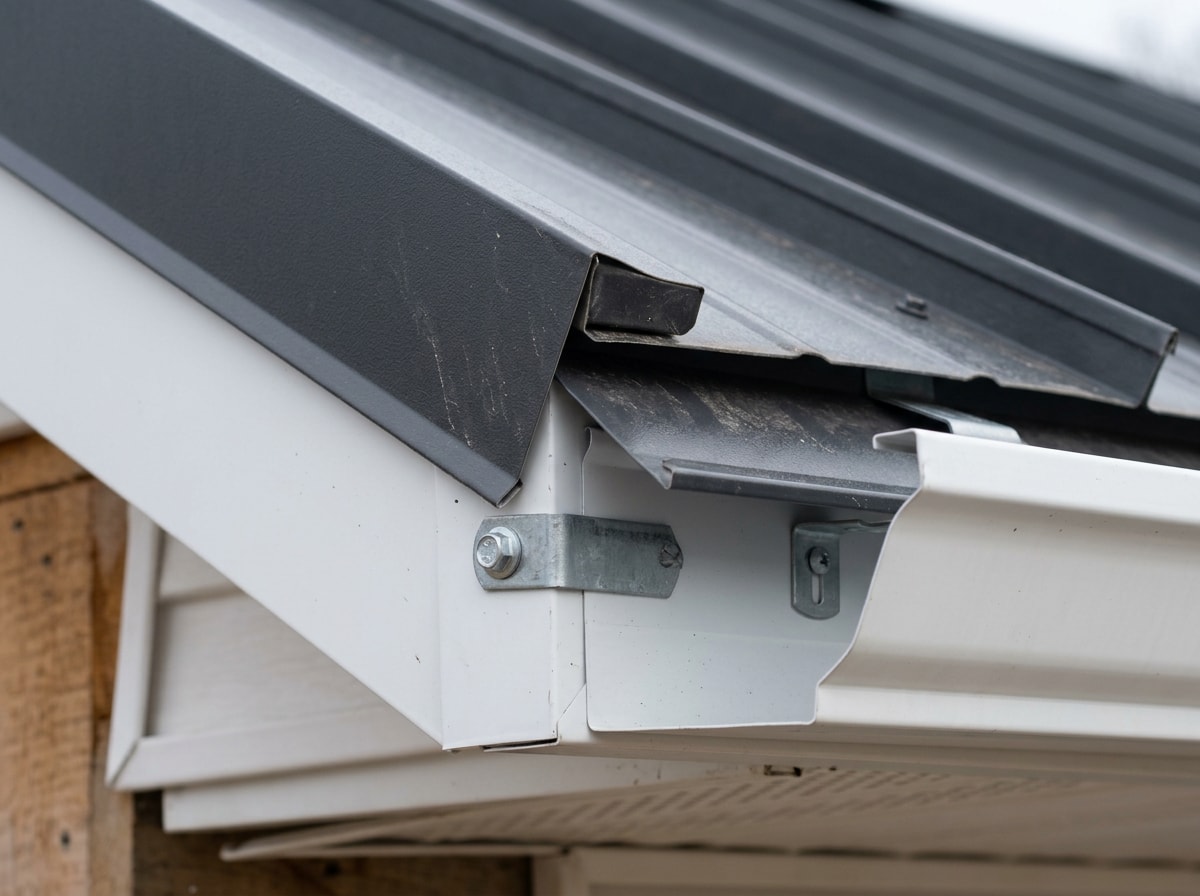
- A gutter apron tucked under the panel edge so water cannot track behind the trough
The numbers behind that: a 6 inch K-style trough carries roughly 40 percent more water than a 5 inch, and a 3x4 downspout moves close to twice the volume of a 2x3. On a steep metal slope, that difference is what keeps water in the gutter during a 15 minute summer downpour instead of sheeting over the front lip onto your foundation.
Steeper panels throw water farther, so the gutter often sits slightly outboard with the roof edge projecting into the trough. Snow retention changes the detail again, since snow guards hold the load upslope instead of dumping it at the eave.
Hangers fasten into solid fascia or sub-fascia. Never through roof panels.
Sizing and layout for your specific roof area is covered on our gutter service page, and 6 inch K-style gutter installation is the profile we hang most often on metal in Chatham.
Metal Roof Gutter Cost in Chatham, IL (2026)
Expect roughly $9 to $18 per linear foot installed for seamless aluminum in the Chatham area in 2026, and about $2,000 to $4,200 for a typical whole-house job. Metal-roof homes usually land in the upper half of that band because of the larger trough and the extra downspouts.
These are planning ranges. Only a measured quote is accurate.
| Line item | Typical 2026 range | Notes |
|---|---|---|
| Seamless gutter, material and labor | $9 to $18 per linear foot | Roll-formed on site, 5 inch to 6 inch |
| Downspouts and elbows | $50 to $120 each installed | 3x4 costs more than 2x3 |
| Gutter guards | $6 to $14 per foot added | Varies by guard type |
| Tear-off and disposal | A few hundred dollars | Average single-story home |
| Fascia repair | Priced after the old run comes down | Only if rot is found |
Upgrade math on the same 180 foot house: stepping .027 aluminum to .032 adds roughly 10 to 15 percent, galvanized steel can run 40 to 70 percent above .027, and moving 5 inch to 6 inch usually adds about $1.50 to $3.00 per foot plus the larger downspouts.
A written quote should itemize those lines separately. If you want a checklist for reading one, our guide to what a written estimate should include applies to exterior work too.
Get a free estimate and we will measure the actual runs and roof area instead of quoting by guess.
How to Hang Gutters on a Metal Roof Without Voiding the Warranty
This is where metal-roof homeowners get burned. Common warranty-voiding mistakes:
- Drilling or screwing through roof panels
- Removing or re-cutting factory eave trim
- Letting incompatible metals touch the panel or sit in its runoff
- Using sealants the panel manufacturer has not approved
- Clamping to standing seams with unapproved hardware
The compliant method is simple. Hangers go into fascia or sub-fascia only. A gutter apron carries runoff over the back lip. Fasteners and sealants come from the approved list in the panel literature.
Keep in mind that three separate warranties are in play: the coil or finish warranty from the gutter manufacturer, the workmanship warranty from your installer, and your existing roof warranty. Get workmanship terms in writing with a stated duration, a defined scope and a plain list of what voids coverage.
The Metal Construction Association's technical bulletin on metal roof design for cold climates covers eave icing and how gutters are separated and detailed at the eave , and it is worth reading before anyone touches your roof: MCA Metal Roof Design for Cold Climates.
Then there is galvanic corrosion, which most pages skip. Keep copper away from aluminum, Galvalume or bare steel, because copper runoff pits them. Do not put plain steel or copper fasteners on aluminum gutters. Use aluminum or stainless, and isolate dissimilar metals with butyl tape or coated washers where they must meet.
Aluminum, Steel or Copper on a Metal Roof
Material drives cost, lifespan and how well the gutter survives a snow slide.
| Material | Typical gauge or thickness | Expected service life | Relative cost | Best use on a metal roof |
|---|---|---|---|---|
| Aluminum | .027 | 20 to 25 years | $ | Short, sheltered runs; budget replacements |
| Aluminum | .032 | 25 to 30+ years | $$ | Standard choice for most Chatham metal roofs |
| Galvanized steel | 26 to 28 ga, G90 coating | 20 to 25 years | $$ | Long runs, snow-slide eaves, north exposures |
| Galvalume steel | 26 ga | 30 to 40 years | $$$ | Matching a Galvalume roof panel |
| Copper | 16 to 20 oz | 50+ years | $$$$ | Historic or architectural homes |
Aluminum will not rust, carries the widest color range for matching roof panels, and expands and contracts predictably, which is why long seamless runs behave well. Step up from .027 to .032 if your eaves take sliding snow.
Galvanized steel resists denting better than any aluminum. The coating is what fights rust, though, so trapped debris and standing water shorten its life.
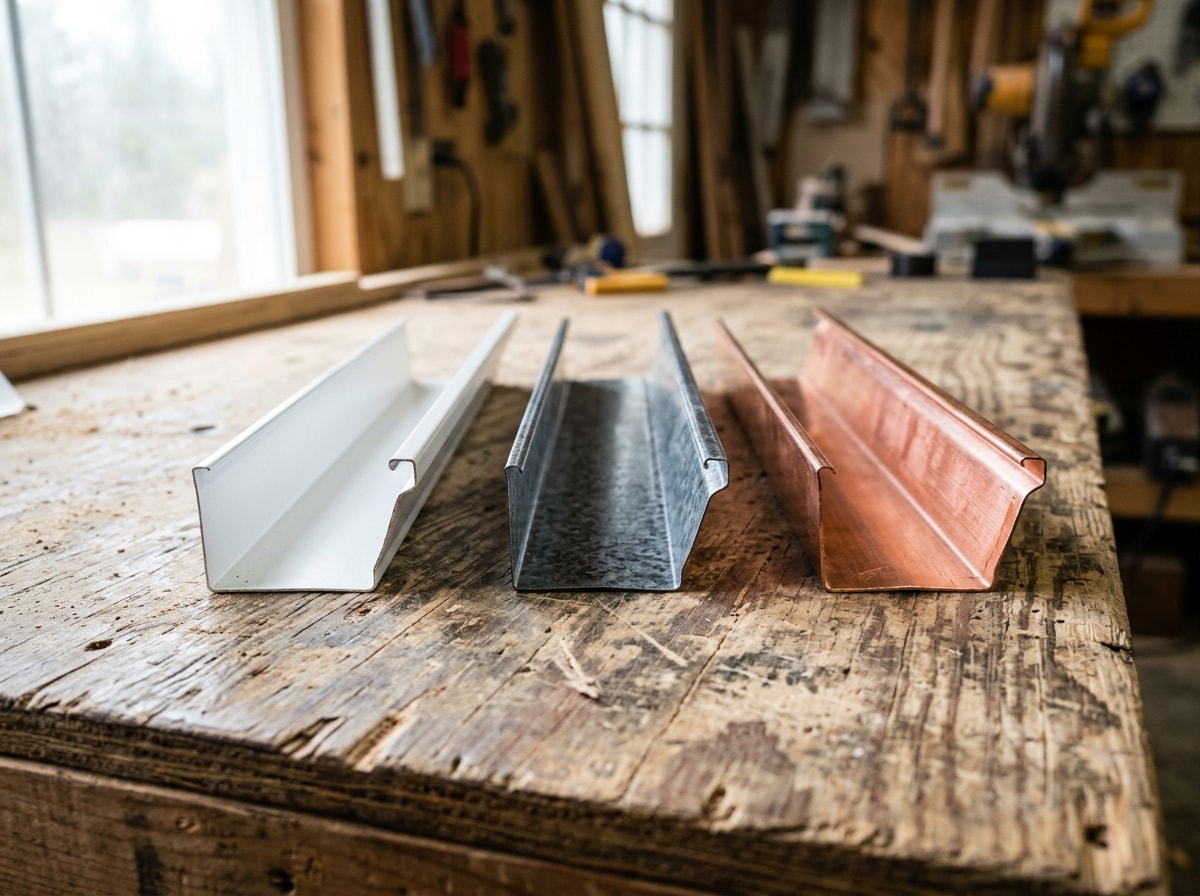
On a Chatham install three winters back, a long north-facing eave under a steep standing-seam slope had already crushed one set of .027 aluminum. We went to 26 gauge steel, pulled hanger spacing to 16 inches, and added snow guards upslope. It is still straight and still draining.
Snow Slide and Ice Dams at a Metal Eave
Snow does not creep off metal. It releases in slabs that hit the gutter hard, then meltwater refreezes at the cold eave and backs up behind the trough. Across the metal-roof calls we run each winter in Chatham, Sherman and Rochester, two failures account for nearly all of them: hangers torn out of soft fascia by a snow slide, and back-pitched sections on eaves that never got a gutter apron.
The fixes stack:
- Snow guards on the roof to control the slide
- Heated gutter cable to keep a drain path open at the eave
- Air sealing, insulation and ventilation in the attic to stop the heat loss that drives the melt
That third one is the root cause, not the symptom. Adding attic insulation combined with attic air sealing helps alleviate the formation of ice dams in winter , according to ENERGY STAR's attic insulation guidance.
Do not chip ice off a gutter and do not lean a ladder against an iced metal roof. That is professional work, and the footing on a frosted panel is unforgiving.
Repair or Replace: What Metal-Roof Gutters Actually Fail At
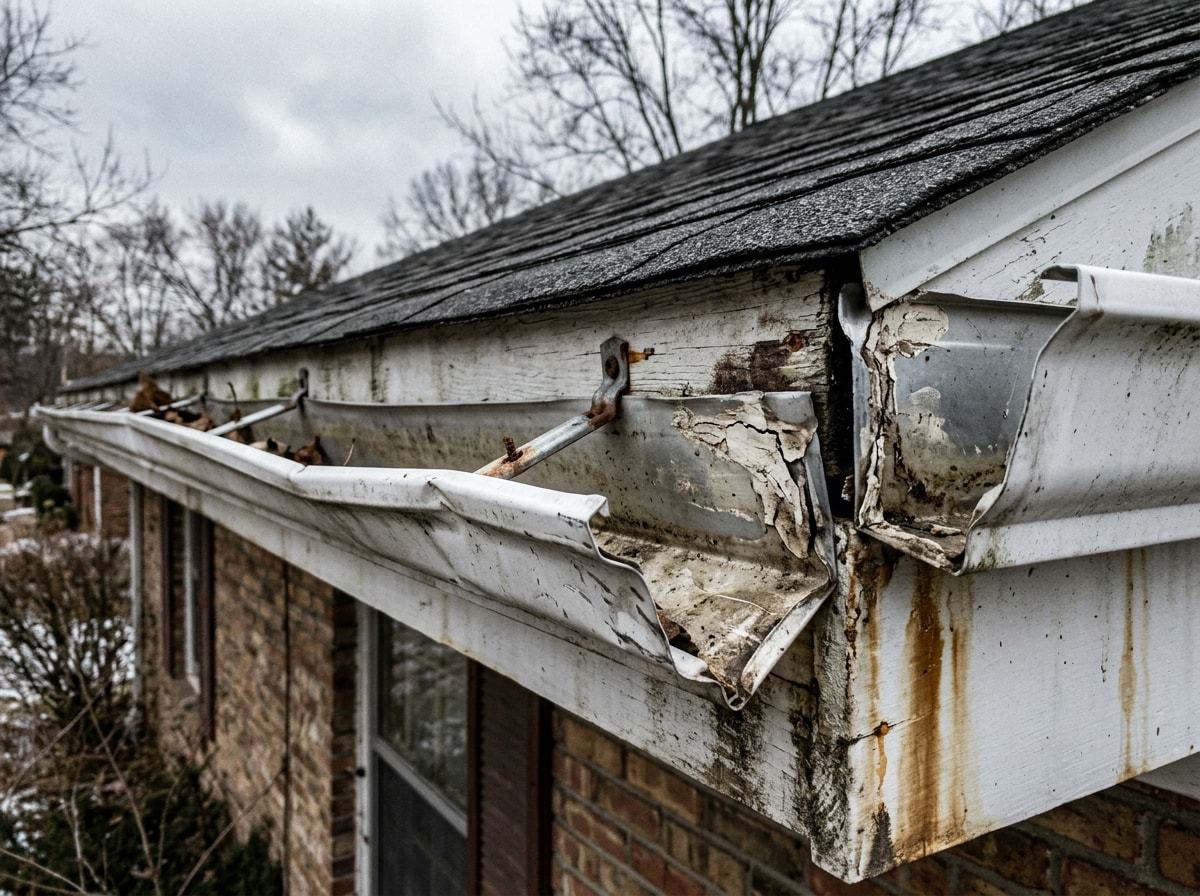
Failures here are predictable:
- Pulled or sagging runs where ice load tore hangers out of soft fascia
- Separated end caps and mitered corners
- Clogged or undersized downspouts
- Back-pitched sections holding standing water
- Bent drip edge or crushed front lip from a snow slide
Leaking miters are usually a fair repair. Clean, re-fasten, then reseal with a compatible sealant, which is what our gutter repair and sagging gutter repair crews do most days.
Once a run is dented, out of pitch in several spots, or the fascia behind it is rotted, replacement is cheaper than chasing it. Soft wood behind the gutter means fascia repair comes first, because new hangers in punky fascia fail the same way the old ones did.
Why Seamless Matters More Under Metal
Seamless gutter is roll-formed on site from a continuous coil and cut to your exact run length. The only joints are at corners and outlets. Sectional gutter snaps together every 10 feet, and every one of those seams is a future leak.
Under a metal roof, where runoff arrives fast and hits the trough hard, fewer joints means less resealing, less fascia rot and fewer winter failures. You also get a cleaner uninterrupted line along the eave and color matching to your roof panels and trim.
The honest trade-off: on-site roll forming needs a truck-mounted machine, so seamless gutter installation is not a weekend project.
Gutter Guards on a Metal Roof
Guards are the biggest lever on maintenance time, but the choice is pitch-dependent.
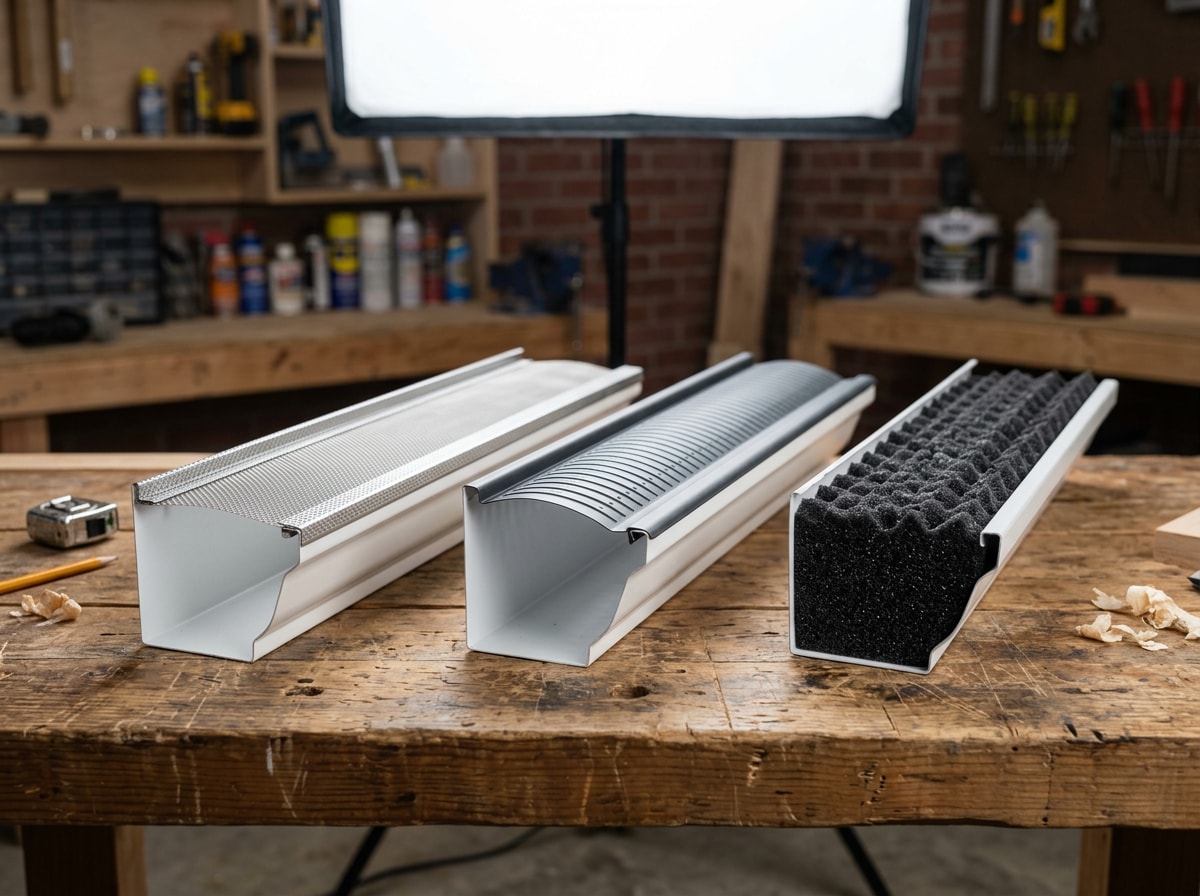
- Micro-mesh handles fine debris and grit best and needs occasional brushing
- Reverse-curve sheds leaves well and clogs less at the mouth
- Foam inserts cost least and tend to hold seed and grit over time
Here is the metal-roof wrinkle: high-velocity runoff off a steep panel can shoot straight over some reverse-curve profiles. Match the guard to the roof pitch deliberately, which is why we walk the eave before quoting gutter guards or micro-mesh gutter guard installation.
Oversized downspouts move debris instead of trapping it. Trim limbs overhanging the eave. Extend discharge four to six feet past the foundation. Guards reduce cleaning frequency. They do not end it, so keep spring and fall gutter cleaning on the calendar along with an annual gutter inspection.
Hiring an Installer: License, Insurance, Local Registration
A metal roof narrows the field fast. The installer needs to be comfortable detailing to a metal eave, not just hanging aluminum on a shingle house.
Verify three things before signing:
- State license.
Illinois does not require a state-level general contractor license, but the state does license roofing contractors through the Illinois Department of Financial and Professional Regulation . Check status on the IDFPR roofing contractor page.
- Insurance. A current general liability certificate plus workers' compensation, with your project address named.
- Local registration.
All contractors must be registered with the Village of Chatham before a permit is approved , so ask whether your installer is already on file.
Questions worth asking at the estimate:
- How will hangers be attached, and at what spacing?
- Will anything penetrate the roof panels?
- What gutter size and how many downspouts for my roof area?
- How are you handling drip edge or gutter apron at the eave?
- Are dissimilar metals in contact anywhere, and how are they isolated?
- Do these runs need snow retention above them?
- Where does the water discharge?
- Is the estimate itemized for tear-off, fascia repair and guards?
FAQ
Do metal roofs need gutters?
Almost always. Metal sheds more water, faster, than asphalt, which makes foundation protection more important, not less. The exceptions are rare: very deep overhangs, engineered ground drainage, or rain chains over a drywell. In central Illinois, skipping gutters invites basement seepage, erosion at the drip line and freeze-thaw damage along the foundation.
Can you attach gutters to a metal roof without drilling the panels?
Yes, and that is the correct method. Hangers go into fascia or sub-fascia, and a gutter apron bridges the gap between the panel edge and the back of the trough. Nothing should penetrate the roof panel itself.
Aluminum or steel gutters for a metal roof in Chatham?
Aluminum when cost, corrosion resistance and color matching matter most, which covers most homes here. Steel when the run is long, the pitch is steep, or snow regularly slides onto that eave, because steel resists denting and ice load far better.
How long do galvanized steel gutters last?
Roughly 20 to 25 years in our climate, sometimes longer with a heavier G90 coating and consistent cleaning. Rust starts where coating is scratched or debris holds moisture against the metal. Aluminum typically runs 20 to 30 years, and copper commonly exceeds 50.
What size downspouts go with a 6 inch gutter?
3x4. Pairing a 6 inch trough with 2x3 downspouts creates a bottleneck, since the 3x4 moves close to twice the volume. Plan one outlet per 30 to 35 feet of run and more on long metal slopes. We size them during downspout installation.
Do I need a permit for gutter replacement in Chatham?
Straightforward gutter replacement typically does not require a permit, while roof replacement or structural fascia work usually does. The Village of Chatham handles code enforcement and building questions from 116 E. Mulberry Street, Chatham, IL 62629, at 217-483-2451 . Confirm before scheduling, since thresholds change and properties outside village limits fall under Sangamon County.
Is DIY gutter work on a metal roof realistic?
Adding a downspout extension or clearing a ground-level elbow is fine. Anything at eave height on a two-story, or ladder work alongside a slick metal panel, is worth hiring out. A screw through a panel or a hanger that misses solid fascia creates leaks and complicates warranty claims later.
Service Area
We install and service seamless gutters in Chatham, IL 62629 and across Sangamon County, including Springfield, Auburn, Rochester and New Berlin.
If your address sits just outside those communities, start at our home page or contact us for a free measured quote. Coverage runs a bit farther in several directions.