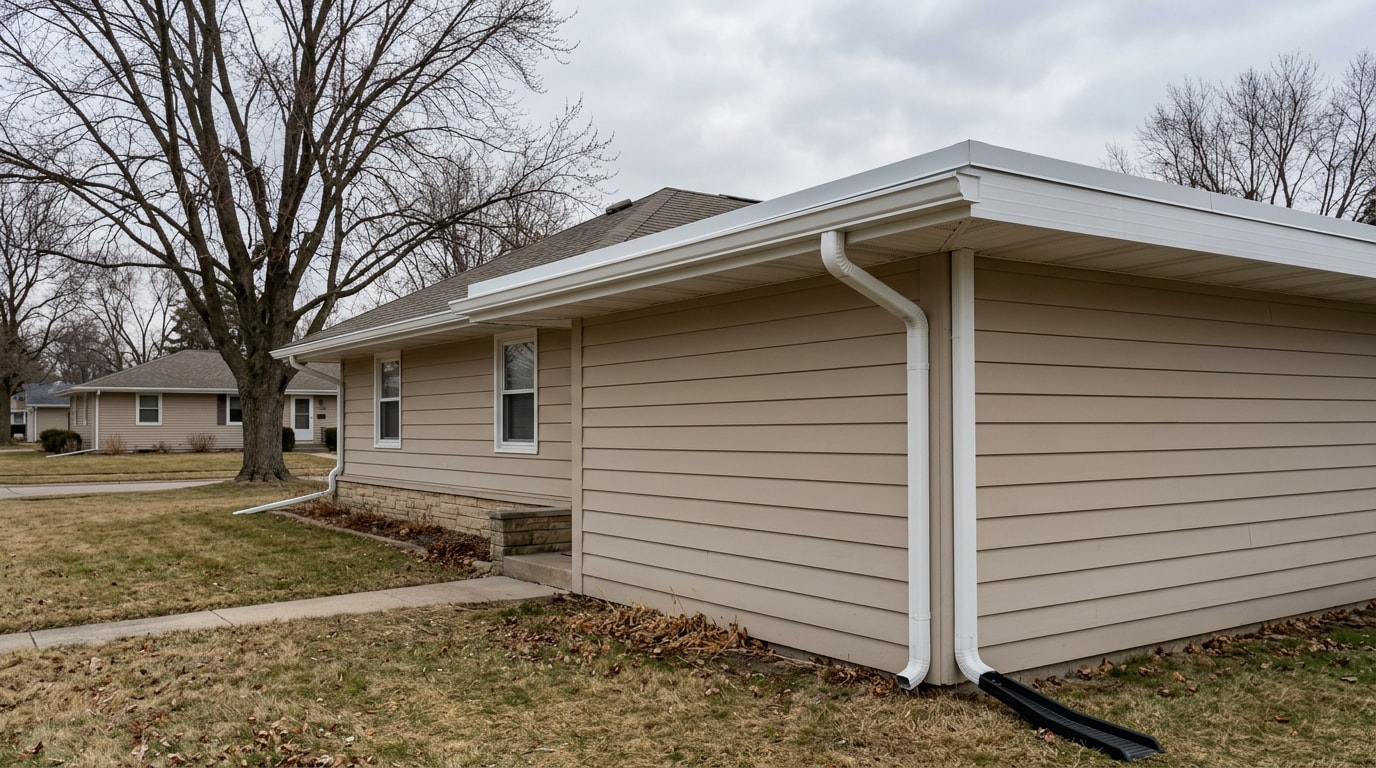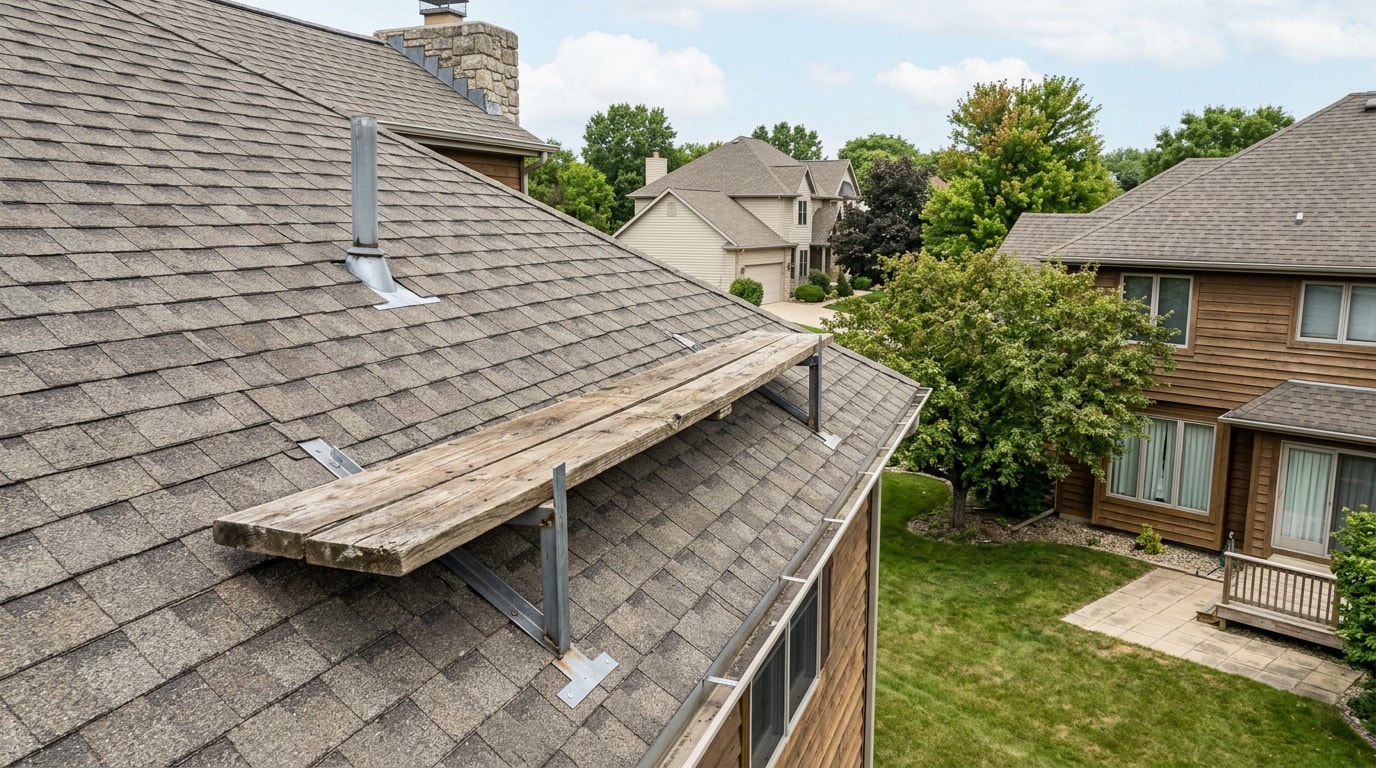

Flat roof gutters in Central Illinois Region, IL have to do a job that standard eave gutters were never built for: moving water off a surface with almost no pitch. Get the slope, material, or drainage type wrong and you end up with standing water, sagging brackets, and a membrane that wears out years ahead of schedule. This guide walks through the drainage options, materials, installation standards, and costs that actually apply to flat and low-slope roofs in this region.
Do Flat Roofs in Central Illinois Need Gutters?
Pitched roofs shed water fast. Flat roofs do not. Without a steep slope pushing rain toward the edge, water sits longer and needs a controlled, engineered exit path instead of just running off.
Building code backs this up. Under the International Residential Code, flat and low-slope roofs are held to a "positive drainage" standard. The code does not force every flat roof to have gutters specifically, but it does require that water be carried off the roof without pooling or causing structural damage, which is exactly what a correctly sized gutter, scupper, or internal drain is designed to do. You can read the exact language in IRC Chapter 9, Section R903.4.
Even roofs with internal drains usually benefit from a secondary path. Skipping drainage altogether does not just risk leaks. It shortens the life of the membrane underneath.
Flat Roof Drainage Options: Scuppers, Internal Drains, and Gutters
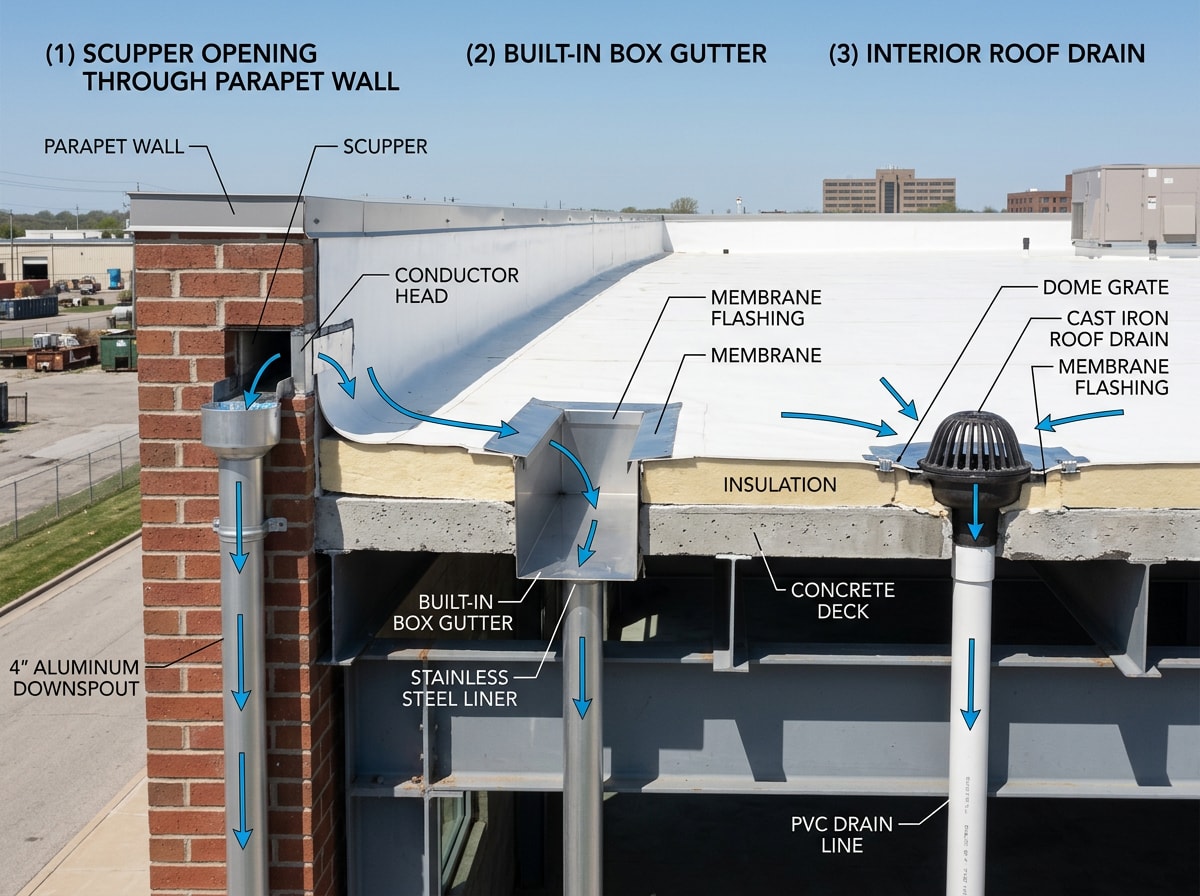
Flat roofs drain in one of a few ways, and the right choice depends on whether the roof edge has a parapet wall or is open.
- Scuppers are openings cut through a parapet wall that let water exit directly, usually paired with a downspout on the outside face of the building.
- Internal drains sit in the roof deck itself and route water through piping inside the structure, common on roofs fully enclosed by parapet walls.
- Box gutters run along the roof edge in a built-in channel. They hold more water than a standard trough, which makes them useful on larger low-slope sections.
- Fascia-mounted gutters attach to the roof's edge board, similar to a pitched-roof gutter, but wider and set with extra drainage slope to make up for the roof's minimal pitch.
Open-edge flat roofs without parapet walls generally work best with fascia or box gutters. Parapet-wall structures lean toward scuppers or internal drains. A contractor who inspects the roof's edge detail in person can confirm which system actually fits.
If your flat roof section sits next to a metal roof, drainage sizing gets more specific. Our metal roof gutter sizing guide for Chatham, IL covers how pitch and panel type change gutter capacity.
Best Gutter Materials for Central Illinois Flat Roofs
Material choice affects cost, weight, and how long the system holds up through Midwest freeze-thaw swings.
| Material | Cost Tier | Typical Lifespan | Central Illinois Suitability |
|---|---|---|---|
| Aluminum | Moderate | 20-25 years | Strong; resists rust, handles freeze-thaw well |
| Galvanized Steel | Moderate-High | 15-20 years | Good, but watch for coating wear |
| Copper | High | 50+ years | Excellent; minimal corrosion over time |
| PVC/Vinyl | Low | 10-15 years | Fair; can crack in deep winter cold |
Aluminum is the most common pick for a reason. It is lightweight and naturally corrosion-resistant, which is part of why it is the standard material referenced for architectural and structural building applications by the Aluminum Association. Copper costs more upfront but can outlast several roof generations. PVC is the cheapest option but gets brittle once temperatures drop hard, which matters on a Central Illinois roof in January.
Actual lifespan depends heavily on coating thickness and installation quality, so treat these figures as general guidance, not a guarantee. If you are deciding between a sectional or seamless gutter installation, seamless runs have fewer joints, which matters even more on a flat roof where water sits longer at every seam.
How Flat Roof Gutter Installation Works
A good installation starts with the right slope, moves to secure bracket spacing, and ends with flashing that ties cleanly into the roof membrane.
Here is where a lot of online advice gets sloppy: the building code does not actually specify a numeric gutter slope. It only requires "positive drainage," as noted above. The 1/4-inch-per-10-feet pitch you will see quoted everywhere comes from manufacturer installation guides and trade standards, not a code book. It is still the right number to build to, because it is what keeps water moving toward the downspout instead of sitting still.
A few other things matter just as much as slope:
- Flashing at the roof edge. A gap where the gutter meets the membrane is one of the most common leak points on flat roof systems.
- Bracket spacing. Standing water adds real weight, so brackets need to be closer together than they would on a dry-running pitched roof.
- Fastener compatibility. Mixing metals, like a steel screw in an aluminum gutter, invites galvanic corrosion at every contact point.
Most of these mistakes are not obvious until months later, which is why flat roof work is one area where professional gutter installation earns its cost. Our gutter service team handles the slope calculations and flashing tie-in on-site, rather than relying on a one-size-fits-all install.
Seasonal Maintenance for Flat Roof Gutters in Central Illinois Region, IL
Flat roof gutters trap debris more than sloped gutters do, since nothing naturally washes off a low-slope surface on its own.
Central Illinois weather adds a real seasonal rhythm to that maintenance:
- Spring storms bring heavy debris loads and sudden downpours that expose undersized systems fast.
- Summer rain events raise overflow risk if gutters were not cleared heading into the season.
- Fall is the biggest clogging risk. Leaves pile up on flat surfaces with nowhere else to go, so plan on clearing gutters at least twice during peak leaf drop.
- Winter brings freeze-thaw cycles that stress brackets, seams, and flashing on low-slope systems. Springfield averages well over 100 days a year with a low temperature at or below freezing, based on 1991-2020 National Weather Service climate normals, and the first freeze typically lands around October 20. That is a long stretch of freeze-thaw exposure for any trapped water sitting in a gutter run.
In our own service calls, the spike in flat roof gutter problems almost always follows that first hard freeze of the season, when water that was sitting in a poorly pitched run finally expands and pushes a seam or bracket loose. Homeowners in Central Illinois Region, IL see that pattern every year. If climbing a ladder twice a season is not realistic, gutter guard installation cuts down on how often debris builds up between cleanings, and routine gutter maintenance catches small sealant and bracket issues before they turn into a leak.
Common Flat Roof Gutter Problems and Fixes
| Problem | Usual Cause | Fix |
|---|---|---|
| Standing water in the gutter | Insufficient slope or a clogged outlet | Re-grade the run or clear the blockage |
| Overflow during heavy rain | System undersized for roof catchment area | Step up to a larger profile or add a scupper |
| Recurring clogs | No seasonal cleaning routine | Set a twice-a-year clearing schedule, more in heavy tree cover |
| Sagging or pulling brackets | Age, water weight, or wide bracket spacing | Replace fasteners and add supports before it leaks |
A leaking gutter almost always traces back to a flashing gap or a failed seam, while a sagging gutter is a bracket and weight-load problem. Treating the two the same way rarely fixes either one for good.
What Flat Roof Gutters Cost in Central Illinois Region, IL
Flat roof gutter pricing depends on several moving parts rather than one flat per-foot rate:
- Material is the biggest factor. Copper costs considerably more than aluminum or PVC.
- System type matters too. Box gutters and internal drains involve more labor than a simple fascia-mounted run.
- Roof size and edge complexity, including multiple parapet walls or odd angles, adds installation time.
- Add-ons like leaf guards or extra downspouts raise the total.
Because pricing shifts with material costs and the specifics of your roof, a project-specific estimate is worth more than a national average. Contact us for a free estimate built around your actual roof, not a rough range pulled from somewhere else.
FAQ
Do flat roofs need gutters?
In most cases, yes. Even roofs with internal drains benefit from a secondary drainage path, since standing water adds weight and speeds up membrane wear. Gutters give rainwater a controlled exit instead of letting it pool or run off unevenly.
Can you put a regular gutter on a flat roof?
Not usually, and not without changes. A standard K-style gutter is sized for a steep roof's fast runoff. Flat roof conditions call for a wider profile, a steeper built-in drainage slope, or a different system entirely, like a scupper or box gutter, to handle water that pools longer before moving.
What is the best gutter system for a flat roof?
It depends on whether the roof has a parapet wall. Open edges without a parapet generally work best with fascia or box gutters. Roofs enclosed by a parapet usually need scuppers or internal drains instead, since there is no open eave for water to run off of.
How often should flat roof gutters be cleaned?
Plan on at least twice a year, with an extra check during peak fall leaf drop. Flat roofs do not shed debris the way pitched roofs do, so buildup sits in the gutter until someone clears it out.
How much does it cost to install gutters on a flat roof?
Cost depends on material, drainage type, and roof complexity rather than a flat rate. Copper systems cost more than aluminum or PVC, and box gutters or internal drains involve more labor than a simple fascia-mounted run. An on-site estimate is the only way to get an accurate number for a specific roof.
About This Guide
This guide was written by the Central Illinois Gutters team, who install and repair flat roof drainage systems across the region and see the seasonal failure patterns described above firsthand on service calls. Visit the Central Illinois Gutters homepage to see the full range of services, or get in touch with questions about a specific roof.